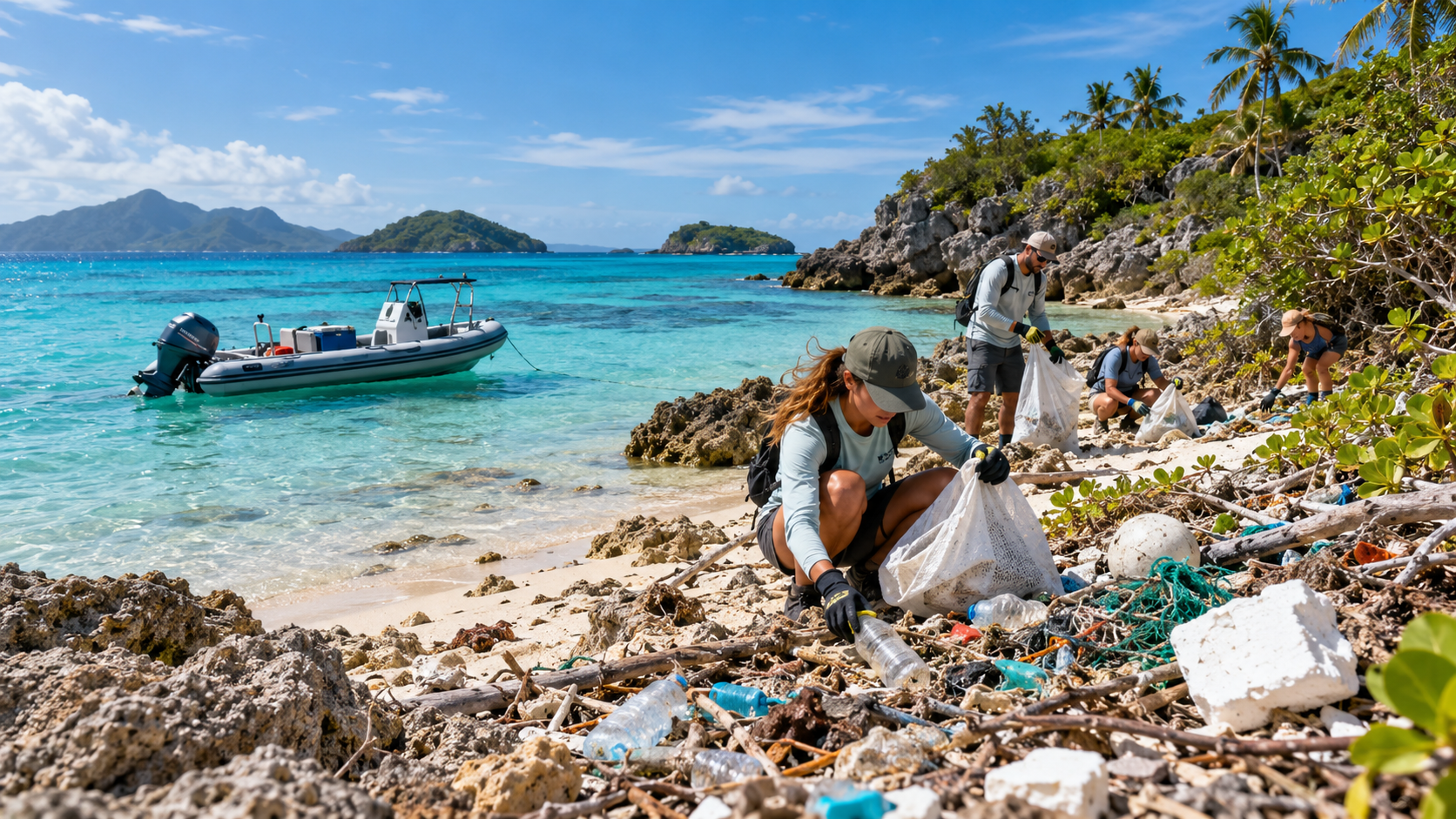
Real Cycle is raising $25,000 to launch the first No Plastics Left Behind expedition—a new field initiative focused on recovering marine debris from difficult-to-access shorelines and understanding what happens to that waste after it is collected.
I have spent much of my professional life thinking about waste, materials, energy and infrastructure.
But the idea behind Real Cycle’s newest project started somewhere much simpler:
On the water.
I love the ocean. And the more time you spend on boats and exploring coastlines, the more you notice something that is easy to miss from a developed beach.
Plastic waste does not only wash up where people can see it.
It collects in coves, on small islands, along mangrove shorelines and on remote stretches of coast with little or no road access. Some of these places are extraordinarily beautiful. They may also contain plastic bottles, packaging, fishing gear, foam, rope, nets and other marine debris carried by currents and tides.
Because these shorelines are difficult to reach, much of that material can simply remain there.
That is why Real Cycle is launching No Plastics Left Behind—the Real Cycle Remote Shoreline Recovery Project.
The idea is straightforward: use marine access to reach shorelines conventional cleanup efforts have difficulty reaching, remove accumulated debris, document what we find and follow the material far enough downstream to understand what actually happens to it.
Learn more about the project and help launch the first expedition on the No Plastics Left Behind project page.
Beach Cleanups Work—Where People Can Get to the Beach
There are already many excellent beach cleanup programs, and they deserve support.
Here in Jupiter, Florida, for example, citizen- and volunteer-led cleanups regularly help protect our local shoreline. Similar efforts take place in coastal communities around the world.
These programs make a real difference. Volunteers can arrive by car, collect debris, bring bags back to a staging area and connect the collected material with an established waste-management system.
But that model depends on access.
What happens when there is no road?
What happens when the only practical access is by boat?
And what happens when you remove hundreds of pounds—or potentially much more—of bulky marine debris and discover that getting it off the beach was only the first logistical challenge?
That is the gap we want No Plastics Left Behind to explore.
We are certainly not the first people to clean remote shorelines. Organizations and individuals around the world already perform difficult marine-cleanup work.
Our objective is more specific: develop a repeatable Real Cycle field project for difficult-to-access shorelines while documenting not only the cleanup itself, but the entire recovery pathway that follows it.
The Problem Is Bigger Than Picking Up Trash
One of the central ideas behind Real Cycle is that we should judge waste systems by what actually happens to material—not simply by where we initially put it.
Putting something in a recycling bin does not necessarily mean it will ultimately be recycled.
Likewise, putting marine debris into a bag does not mean the waste problem has been solved.
Collection is only the beginning.
The material still has to be transported. It may need to be sorted. Some of it may be recyclable. Some may have another practical resource-recovery pathway. Some marine plastic may be too contaminated, degraded or mixed to recycle economically and may ultimately require responsible disposal.
That reality is important.
As we have discussed elsewhere at Real Cycle, recycling alone will never be enough. Different materials require different solutions, and an effective waste-management system has to account for what happens after collection.
No Plastics Left Behind takes that philosophy out of the classroom and into the field.
Why This Project Interests Me
My professional background is in materials engineering, recycling, resource recovery, energy and infrastructure.
Much of that work ultimately revolves around a deceptively simple question:
What can we realistically do with a material after society no longer wants it?
That same question applies to marine debris.
A plastic container recovered from an isolated shoreline may technically be made from recyclable plastic. But after months or years in the marine environment—weathered, contaminated and mixed with other materials—the practical answer may be much more complicated.
That is exactly why I think this project is worth doing.
Do not stop at collection.
Understand the material.
Understand the logistics.
Understand where it can realistically go.
And document what actually happens.
What We Plan to Do
For the first No Plastics Left Behind expedition, Real Cycle is evaluating potential locations in The Bahamas and Belize. No final site has been selected yet.
The target will be a shoreline where marine access is genuinely necessary—not a beach that could just as easily be reached with a pickup truck.
The operating concept is to use a vessel as a working platform for people, equipment and recovered debris. A dinghy, RIB or other small boat can provide access to shore. The field team can then collect and document marine debris, consolidate it and move it back to the primary vessel.
But that is where the project becomes more interesting.
We want to measure what we recover by weight and volume, document the types of material encountered, examine the labor and transportation requirements and follow the waste through the next steps of the chain.
Where can it legally be landed?
What can actually be recycled locally?
What requires another recovery pathway?
What has no realistic recovery option and must be properly disposed of?
What does it cost to move remote marine debris from an inaccessible shoreline into a legitimate waste-management system?
Those are questions a photograph of a beach cleanup cannot answer.
Field work can.
What We Want to Learn
We intend to document the locations and shorelines surveyed, the quantity and types of debris recovered, and—where practical—information about plastics, packaging, fishing gear, rope, nets, foam and other marine-use materials.
We are also interested in identifying useful source and provenance indicators, including brands, product types, languages and country markings where they are visible.
That does not necessarily tell us where an individual object entered the ocean. Marine debris can travel enormous distances.
But patterns in the material may help us better understand the waste streams accumulating on remote shorelines.
One distinction I am particularly interested in is the difference between lost or abandoned fishing and marine equipment and land-based consumer and commercial packaging.
Those materials may arrive on the same beach, but preventing them from entering the environment in the first place may require completely different solutions.
Why We Are Raising $25,000
Real Cycle has established an initial $25,000 fundraising goal to help launch the first No Plastics Left Behind expedition.
The funds will support the practical requirements of carrying out the project, including marine operations, cleanup and safety equipment, transportation and handling of recovered debris, local logistics, documentation, insurance and other legitimate field-project expenses.
Real Cycle staff are volunteers.
The purpose of the campaign is to put resources into the field work and infrastructure necessary to make the expedition possible.
And we intend to report what we learn.
Success will not simply be a photograph of a cleaner beach.
We want to be able to explain what was collected, what it took to remove it, where the material went, what could realistically be recovered or recycled, what could not, what the project cost and what obstacles prevented better recovery.
That transparency is an important part of the project.
Help us launch the first No Plastics Left Behind expedition. Visit the project page to learn more, follow our progress or make a tax-deductible contribution to Real Cycle.
From an Idea to Something Real
Real Cycle was created because I believe environmental problems need more than slogans.
Plastics are extraordinarily useful materials. The challenge comes when their useful life ends.
If disposal systems fail, durable materials can remain in the environment for years.
If recycling systems do not have viable end markets, collection alone accomplishes less than people assume.
And if waste reaches a shoreline that almost nobody routinely visits, it can effectively become invisible.
No Plastics Left Behind is an opportunity to confront a small part of that problem directly.
Go there.
See what is actually there.
Remove what we can.
Measure it.
Figure out where it can realistically go.
Report what worked and what did not.
And then use what we learn to make the next effort better.
That is what I want this project to become.
If the idea resonates with you, I invite you to help us turn it from an idea into a real expedition.
About the Author
Gregory Merle (Greg Merle) is a materials engineer, energy and infrastructure executive, and project developer whose work spans recycling, resource recovery, power generation and industrial development. He serves as a director and advisor to Real Cycle and as President of FlexOnyx, an advanced recycling initiative focused on difficult-to-recycle plastics.
Learn more about Greg through his Real Cycle biography, FlexOnyx biography, PowerGen Insights biography, or his personal website at GregMerle.com.